
Dough hydration is a foundational yet profoundly nuanced aspect of sourdough bread baking, a process that transcends simple numerical values to become an interactive dialogue between the baker and their ingredients. Far from a static recipe component, hydration dynamically shifts based on environmental factors, flour characteristics, and even ambient humidity, demanding a keen understanding and adaptive approach from the artisan.
This comprehensive guide delves into the multifaceted world of dough hydration, exploring its scientific underpinnings, practical adjustments, and profound impact on the final bread product. It aims to demystify the complexities that often challenge both novice and experienced bakers, offering insights gleaned from years of practical experience and baking science. Understanding hydration is often the critical determinant in resolving common baking dilemmas, from unmanageably sticky dough to dense, tight loaves, and is pivotal to unlocking the full potential of sourdough bread.
Defining Dough Hydration: The Numerical Baseline
In baking terminology, dough hydration quantifies the total water content in a recipe as a percentage of the total flour weight. This critical ratio is calculated using a straightforward formula: the weight of the water is divided by the total weight of the flour, and the result is then multiplied by 100. For instance, a recipe calling for 1,000 grams of flour and 700 grams of water yields a 70% hydration (700 ÷ 1,000 × 100 = 70%). This percentage serves as an initial indicator, offering bakers a predictive understanding of their dough’s anticipated consistency before the mixing process even begins.
However, it is paramount to recognize that this percentage is merely a guideline, not an immutable law. Flour, the primary ingredient, is an inherently variable commodity. Its properties can differ significantly between types, mills, and even individual bags, influencing its water absorption capacity. Furthermore, environmental conditions, particularly dramatic shifts in humidity, can subtly alter flour’s inherent moisture content, necessitating on-the-fly adjustments to achieve optimal dough consistency. A dough that proves perfectly workable at 70% hydration on a dry day might require a slight reduction in water during a period of high humidity to maintain its structural integrity.
The Indispensable Role of Water in Dough Dynamics
Water is not merely a diluent in bread dough; it is the vital catalyst that transforms dry flour into a viscoelastic, living matrix. Its interaction with flour components is critical for several key processes:
- Gluten Formation: The primary proteins in wheat flour, glutenin and gliadin, are insoluble in water. However, upon hydration, they begin to link together through disulfide bonds and hydrogen bonds, forming the intricate, elastic network known as gluten. This network is crucial for trapping the carbon dioxide gases produced during fermentation, enabling the dough to rise and develop an open crumb structure. Insufficient water hinders gluten development, resulting in a tight, underdeveloped dough.
- Starch Gelatinization: Water is absorbed by starch granules, causing them to swell. During baking, as temperatures rise, these starch granules further absorb water, swell, and eventually rupture, releasing amylose and amylopectin. This process, known as gelatinization, contributes significantly to the bread’s crumb structure, texture, and moisture retention.
- Enzyme Activity: Water facilitates enzymatic reactions within the dough, particularly those involving amylase enzymes that break down starches into simpler sugars. These sugars serve as fuel for yeast and lactic acid bacteria in the sourdough starter, driving fermentation and contributing to flavor development.
- Dough Rheology: The amount of water directly dictates the dough’s consistency – its stickiness, extensibility, and elasticity. These rheological properties influence how easily the dough can be mixed, kneaded, shaped, and ultimately, how it performs during proofing and baking.
Impact of Hydration Levels on Final Bread Characteristics
The chosen hydration percentage profoundly influences the sensory attributes of the final loaf, creating a spectrum of bread styles.
-
Lower-Hydration Bread (60-68%):
- Dough Handling: Easier to manage, less sticky, holds shape well.
- Crust: Typically thicker, more substantial, and often chewier.
- Crumb: Denser, tighter, with a more uniform cell structure.
- Flavor: Can exhibit a more concentrated, sometimes less complex flavor profile due to reduced water for enzymatic activity.
- Examples: Traditional bagels, pretzels, certain pan loaves, some rustic French baguettes, and country-style breads. These breads often prioritize a sturdy structure and a hearty chew.
-
Higher-Hydration Bread (75-85%+):
- Dough Handling: More challenging to work with, stickier, requires gentle handling and specific techniques.
- Crust: Thinner, crisper, and more delicate, prone to shattering.
- Crumb: Characterized by a more open, irregular, and airy cell structure, often described as "custardy" or "gel-like" in texture.
- Flavor: Enhanced enzymatic activity and longer fermentation often lead to more complex, nuanced flavors.
- Examples: Ciabatta, focaccia, many modern artisanal sourdough loaves, and breads designed for a very open crumb. These loaves are prized for their light texture and intricate flavor.
While many contemporary sourdough enthusiasts gravitate towards higher hydration for its distinctive open crumb and tender texture, it is crucial to understand that "higher" does not automatically equate to "better." Excessive hydration, pushed beyond the flour’s capacity and the baker’s skill, can compromise the dough’s structural integrity, leading to a loaf that collapses, exhibits a gummy crumb, and stales rapidly. The objective is to find a hydration level that optimizes volume, texture, and eating quality for the specific flour and desired outcome, rather than chasing arbitrary high numbers.
Factors Influencing Water Absorption Capacity
Several variables dictate how much water a given flour can absorb:
- Flour Type and Protein Content: This is arguably the most significant factor. Higher-protein flours (typically 12-14% protein, common in North American "bread flour") possess a greater capacity for gluten formation and thus can absorb and retain more water. They often require this higher hydration to prevent a gummy texture. Conversely, lower-protein "softer" flours, often found in Europe and other regions, will yield an unmanageably sticky dough at high hydration levels and necessitate a reduction in water. The specific genetic makeup of the wheat variety also plays a role in protein quality and water absorption.
- Whole Grain Flours: Flours containing bran and germ (e.g., whole wheat, rye, spelt) absorb considerably more water than refined white flours. The fibrous bran acts like a sponge, drawing in moisture. Additionally, the bran can interfere with gluten development, requiring more water to achieve a comparable dough consistency and to ensure a tender crumb. Recipes incorporating significant percentages of whole grains often feature hydration levels upwards of 80%.
- Freshly Milled Flour: Freshly milled flour tends to exhibit higher water absorption compared to aged or commercially processed flour. This is attributed to the intact starch granules and proteins, which rapidly absorb moisture. Bakers working with fresh flour often find they need to increase hydration to achieve the desired dough consistency and texture.
- Climate and Environment: Ambient conditions play a subtle yet measurable role. In arid, high-altitude environments, like New Mexico, flour may dry out faster or have lower inherent moisture, requiring higher hydration percentages. Conversely, in humid climates, flour can absorb moisture from the air, potentially necessitating a slight reduction in recipe hydration. The flour’s initial moisture content, even from bag to bag, can vary.
- Dough Temperature: While not a direct factor in the amount of water absorbed, the temperature of the water used can impact the rate of absorption and the initial feel of the dough. Colder water slows down initial absorption and gluten development, while warmer water accelerates it.
The Art of Bassinage: Staged Hydration
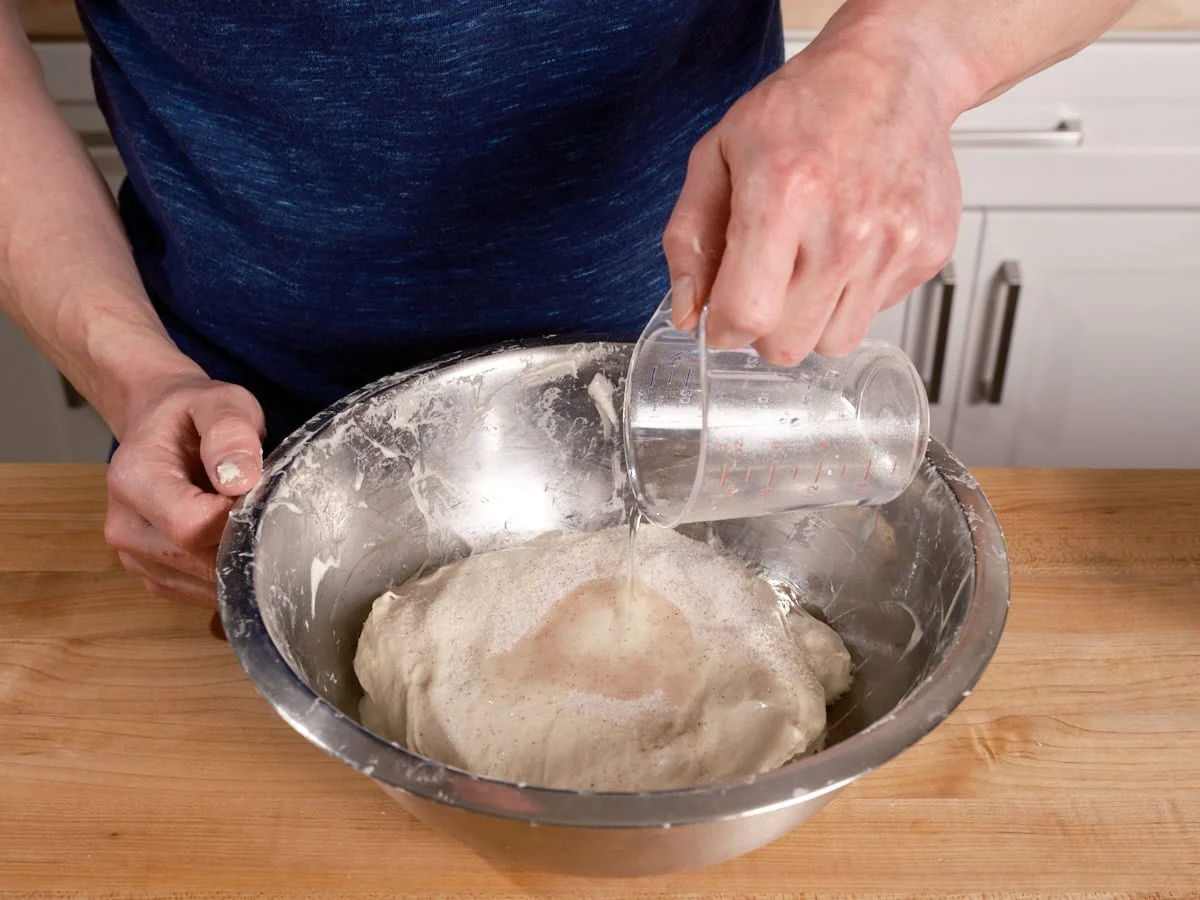
One of the most transformative techniques in managing hydration, particularly for higher-hydration doughs, is bassinage, sometimes referred to as "double hydration." This method involves reserving a portion of the total water and incorporating it gradually during the later stages of mixing, after the initial flour and water (and often levain) have been combined and gluten development has begun.
The benefits of bassinage are manifold:
- Facilitated Gluten Development: Attempting to develop gluten in a very wet dough from the outset can be exceedingly difficult. The high water content reduces friction, making it challenging for the gluten network to form efficiently. By starting with a slightly stiffer dough (using 80-90% of the total water), gluten development can proceed more effectively. Once a foundational network is established, the remaining water can be slowly introduced, allowing for higher hydration without compromising structural integrity or requiring excessively long mixing times.
- Dough Strength Assessment: Bassinage provides the baker with a critical opportunity to "read" the dough. After the initial water addition, the dough’s strength and consistency can be assessed. If the dough feels exceptionally slack, weak, or overly sticky, the reserved water can be partially or entirely withheld. Conversely, if the dough feels strong and cohesive, the remaining water can be confidently incorporated. This adaptive approach ensures the dough achieves optimal hydration tailored to the specific flour and environmental conditions of the day.
This technique is widely adopted in professional bakeries and is a hallmark of many advanced sourdough recipes, often appearing as "Water 1" (for autolyse/levain incorporation) and "Water 2" (the bassinage water for final adjustment).
Troubleshooting Sticky Dough
Sticky dough is a common source of frustration, often stemming from issues related to hydration, gluten development, or a combination thereof. Key culprits include:
- Insufficient Gluten Development: A weak gluten network cannot adequately hold water, leading to a dough that feels soupy and lacks structure. This can result from inadequate mixing, insufficient stretch-and-folds, or using flour with low protein content.
- Over-Hydration: Simply adding too much water for the flour’s capacity will result in a slack, unmanageable, sticky dough that struggles to hold its shape.
- Flour Quality: As discussed, different flours have varying absorption rates. Using a flour that absorbs less water than anticipated for a given recipe can lead to stickiness.
- Improper Handling: Overworking a high-hydration dough with dry hands or on an un-floured surface can exacerbate stickiness. Gentle handling with wet hands or a lightly floured surface is crucial.
- Temperature: A dough that is too warm can feel stickier and more slack. Controlling dough temperature is important for managing its consistency.
Strategies for Managing High-Hydration Doughs
As hydration levels increase, the dough’s inherent stability decreases, pushing the gluten network to its limits. Successful management of high-hydration doughs requires specific techniques:
- Develop Strong Gluten: Longer mixing times (if using a stand mixer) or more frequent, gentle stretch-and-folds during bulk fermentation are essential to build a robust gluten network capable of containing the high water content.
- Utilize Bassinage: As detailed above, adding water in stages is a highly effective method.
- Work with Wet Hands and Tools: To prevent sticking, lightly wet your hands or use a bowl scraper during handling. Avoid excessive flouring of surfaces, as this can alter the overall hydration.
- Gentle Handling: High-hydration doughs are delicate. Employ gentle stretching, folding, and shaping techniques to avoid tearing the gluten network and deflating the dough.
- Adequate Bulk Fermentation: Allow sufficient time for the dough to develop strength and gas retention during bulk fermentation. A properly fermented high-hydration dough will be aerated and cohesive, not a soupy mess.
- Cold Proofing: A cold proof (refrigeration) helps stiffen the dough, making it easier to score and handle before baking, and contributes to better oven spring.
Beyond the Numbers: Cultivating Baker’s Intuition
Ultimately, mastering dough hydration is less about rigidly adhering to a percentage and more about developing "baker’s intuition" – the ability to interpret and respond to what the dough is communicating through its feel and appearance. Every bag of flour presents unique characteristics, and daily kitchen conditions are never identical. The most adept bakers treat recipes as dynamic starting points, engaging in a continuous dialogue with their ingredients.
To cultivate this intuition, consistent observation and meticulous record-keeping are invaluable. Documenting the hydration used, the dough’s tactile qualities, prevailing environmental conditions, and the characteristics of the final loaf creates a personal knowledge base. Over time, this empirical data fosters an intuitive understanding of hydration that no static guide can fully impart. It empowers bakers to adapt, troubleshoot, and consistently produce exceptional bread, transforming a complex scientific process into an intuitive art form.
Happy baking!


