The arrival of warmer weather and the traditional observance of Easter usher in a period of renewed culinary interest, particularly in seasonal baked goods. Among these, the hot cross bun holds a venerable place, traditionally consumed on Good Friday. This year, a notable adaptation of this classic, focusing on sourdough leavening and enhanced texture, has garnered attention within the baking community. Developed and refined from the acclaimed cookbook The Perfect Loaf, this updated recipe for sourdough hot cross buns represents a significant step in marrying traditional flavors with modern baking science, promising a superior sensory experience through a combination of warm spices, bright citrus, plump dried fruits, and a uniquely tender, enriched dough.
The Evolution of a Timeless Treat: Bridging Tradition and Innovation
Hot cross buns, with their distinctive spiced dough and symbolic cross, have been a staple of spring baking for centuries. Historically, these buns relied on commercial yeast for leavening, offering a quick rise but often sacrificing the depth of flavor that a slower fermentation process can impart. The increasing popularity of sourdough baking, driven by a desire for more complex flavors, improved digestibility, and natural leavening, has led many home bakers and professionals alike to experiment with applying sourdough techniques to traditionally yeast-leavened enriched doughs.
The initial recipe for sourdough hot cross buns, featured in The Perfect Loaf cookbook, laid a robust foundation for integrating natural leavening into this seasonal favorite. However, culinary innovation is an ongoing process, and this latest iteration introduces a key scientific advancement: the inclusion of a tangzhong. This technique, originating from Asian baking, is a cooked flour paste that fundamentally transforms the dough’s texture and longevity, pushing the boundaries of what is achievable with naturally leavened enriched breads. This development positions the recipe not merely as an alternative, but as a refined enhancement to the hot cross bun tradition.
Technological Advancements in Dough Science: Tangzhong and Sweet Levain
The core distinction of this evolved sourdough hot cross bun recipe lies in two primary technical adjustments: the incorporation of a tangzhong and the strategic use of a sweet levain. These elements work in concert to address common challenges associated with sourdough enriched doughs, namely achieving exceptional softness and managing the characteristic sourdough tang.
The tangzhong is a pre-gelatinized cooked flour paste. Its function is rooted in the gelatinization of starch molecules in the flour when heated with liquid. This process allows the flour to absorb and retain a significantly greater amount of water than it would otherwise. When this paste is incorporated into the main dough, it traps this extra moisture, leading to a dough that is not only remarkably softer and more tender but also remains fresh for an extended period. This results in a desirable "pillowy, pull-apart texture" that is often difficult to achieve in enriched doughs, especially when naturally leavened. The scientific principle behind tangzhong ensures that the buns retain their moistness and elasticity long after baking, a significant improvement over traditional methods.
Complementing the tangzhong is the utilization of a sweet levain. In standard sourdough baking, the levain (starter) is typically fed with flour and water, resulting in a more pronounced sourness. For enriched doughs like hot cross buns, where sweetness and spice are paramount, an overly sour note can be detrimental. The sweet levain, prepared with a proportion of sugar alongside flour and water, serves a dual purpose. Firstly, the sugar provides an immediate and readily available food source for the yeast and bacteria in the sourdough culture, allowing them to work more efficiently despite the presence of fats and sugars in the enriched dough, which can otherwise slow fermentation. Secondly, and critically, the sugar in the levain helps to mitigate the development of excessive lactic and acetic acids, thereby reducing the overall sourness of the final bun. This careful balance ensures that the sourdough contribution is a "subtle tang" that rounds out the flavors without overpowering the warm spices and inherent sweetness of the bun.
A Symphony of Flavors: Spices, Citrus, and Fruit
Beyond the technical advancements in dough structure, the recipe meticulously balances a rich array of flavors. The spice blend is a cornerstone, featuring ground cinnamon, ground allspice, and freshly ground nutmeg. These spices are chosen for their complementary warmth and aromatic profiles, evoking a comforting and traditional essence. To brighten this warmth, the zest of one lemon and the zest of one orange are incorporated. Citrus zest provides a volatile oil content that infuses the dough with a fresh, vibrant aroma and a subtle acidic counterpoint to the sweetness.
The inclusion of dried fruits is integral to the hot cross bun experience. The recipe specifies Thompson raisins or candied orange peel for one component, and dried currants or chocolate chips for the other. This offers flexibility while maintaining the desired texture and sweetness. An optional "fruit soaker" step, involving hydrating the dried fruits overnight, ensures they become plump and succulent, preventing them from drawing moisture from the dough during baking and resulting in a more enjoyable texture in the final product. The choice of candied orange peel adds a sophisticated, slightly bitter-sweet note, while chocolate chips cater to a more contemporary palate, demonstrating the recipe’s adaptability.
A Meticulously Structured Baking Schedule
The creation of these sourdough hot cross buns follows a precise, multi-stage schedule designed to optimize flavor development and dough structure, while also offering flexibility for busy bakers.
-
Evening (Day 1): Preparation of Sweet Levain and Optional Fruit Soaker (e.g., 9:00 p.m.)
The process begins with the activation of the sweet levain. Water is adjusted to an optimal temperature (around 78°F / 25°C), and the levain ingredients (high-protein white flour, superfine sugar, water, and ripe sourdough starter) are combined. This mixture is allowed to ferment in a warm environment for approximately 12 hours, ensuring it reaches peak activity and aeration. Concurrently, if the dried fruits are deemed excessively dry, they are covered in water and left to soak overnight, enhancing their plumpness. -
Morning (Day 2): Tangzhong and Butter Preparation (e.g., 8:00 a.m.)
The tangzhong is prepared by cooking high-protein white flour and whole milk over medium-low heat until it forms a cohesive paste. This paste is then rapidly cooled to prevent overcooking and to be ready for incorporation into the main dough. Simultaneously, unsalted butter is cut into pats and left at room temperature to soften, ensuring it integrates smoothly into the dough during mixing. -
Mid-Morning: Dough Mixing (e.g., 8:30 a.m.)
Achieving a desired dough temperature (DDT) of 78°F (25°C) is crucial for consistent fermentation. The ripe, bubbly levain is combined with the tangzhong, high-protein white flour, beaten egg, superfine sugar, spices, citrus zests, water, and fine sea salt in a stand mixer. The initial mixing phase combines ingredients and begins gluten development. After a short rest, mixing continues until the dough passes the "windowpane test," indicating intensive gluten development. Room temperature butter is then gradually incorporated, followed by the inclusions (fruits/chocolate chips), mixed on the slowest speed to ensure even distribution without damaging the dough structure. The dough at this stage is described as silky smooth, elastic, and strong. -
Early Afternoon: Bulk Fermentation (e.g., 9:00 a.m. to 1:00 p.m. – approximately 4 hours)
The dough undergoes bulk fermentation in a warm environment (74–76°F / 23–24°C). This phase includes two sets of stretches and folds at 30-minute intervals, which help build strength and evenly distribute the optional fruit soaker (if used). The remaining time allows the dough to rest and develop flavor and volume. Proper bulk fermentation is critical for the final texture and rise of the buns, with the dough expected to become noticeably puffy and elastic. -
Mid-Afternoon: Dividing and Shaping (e.g., 1:00 p.m.)
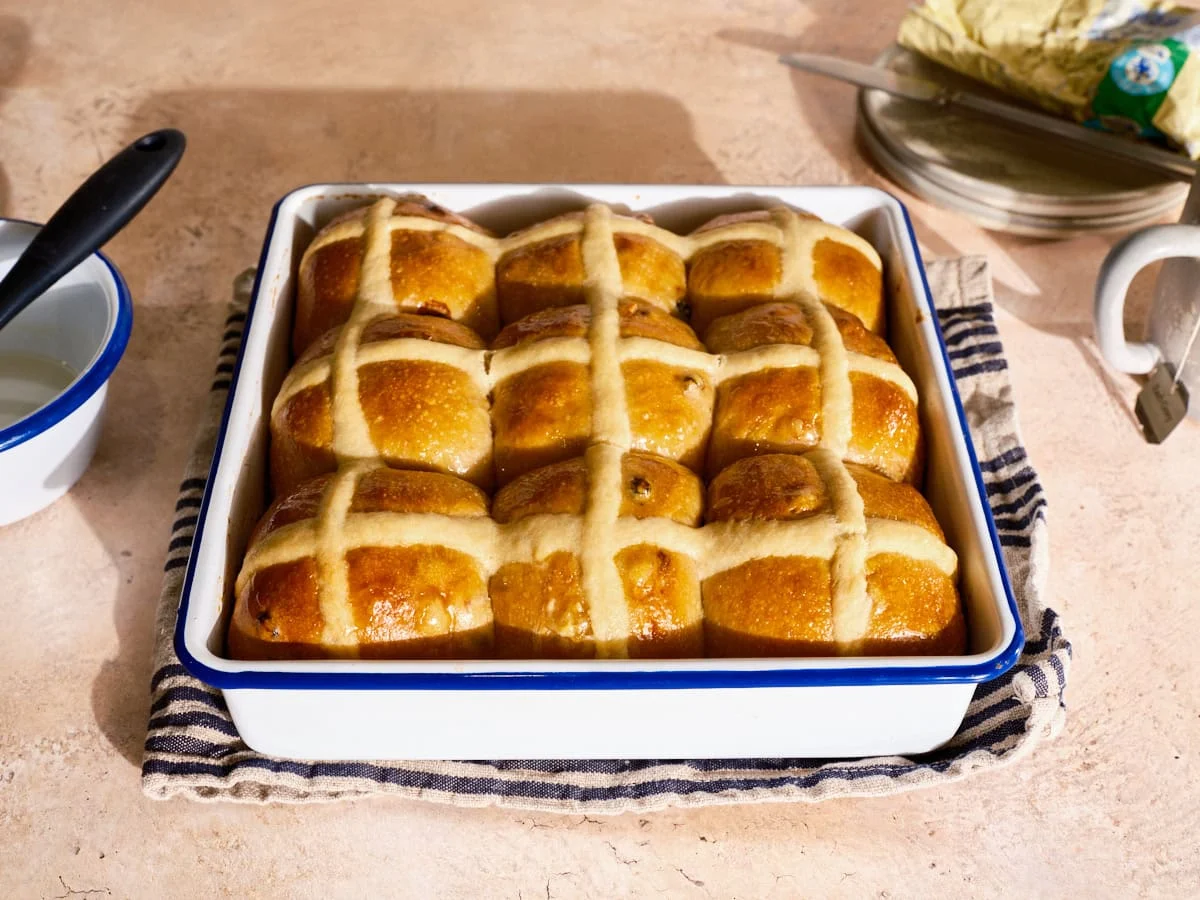
After bulk fermentation, the dough is gently turned out and divided into nine equal pieces, each weighing approximately 115g. Each piece is then shaped into a tight round and arranged in a liberally buttered 9-inch square baking pan. An alternative option is to bake on a sheet pan for a firmer crust. An overnight option allows for the shaped buns to be refrigerated, enabling baking on the subsequent day, ideal for preparation for specific events like Easter morning. -
Late Afternoon: Final Proofing (e.g., 1:30 p.m. to 5:30 p.m. – approximately 4 to 5 hours)
The shaped buns undergo a final proofing in a warm environment. This is a slower process due to the enriched nature of the dough. The buns are considered ready when they are visibly risen, very soft to the touch, and lack any dense spots, ideally reaching just below the rim of the baking pan. -
Evening: Glaze, Cross Mixture, and Baking (e.g., 5:30 p.m.)
The oven is preheated to 400°F (200°C). A simple syrup glaze (water and sugar) is prepared and cooled. The cross mixture, a paste of white flour, water, orange juice (or more water), oil, and salt, is prepared and transferred to a pastry bag. Before baking, the buns are brushed with an egg wash (egg and milk) for color and shine, and the characteristic crosses are piped onto each bun. They are then baked for an initial 15 minutes, followed by a reduction in temperature to 350°F (175°C) for another 10 to 15 minutes, or until golden brown and an internal temperature of 195°F (90°C) is reached.
Serving and Storage: Maximizing Enjoyment
Upon removal from the oven, the hot buns are immediately brushed with the simple syrup glaze, providing a lustrous finish and an additional layer of sweetness. While best enjoyed warm on the day they are baked, preferably sliced in half and spread with high-quality salted butter, they can be stored in an airtight container for up to one day. Reheating in a low oven is recommended to restore their tender texture.
Broader Implications for the Baking Community
This enhanced sourdough hot cross bun recipe reflects a broader trend in the artisan baking community: the continuous pursuit of superior texture and flavor through a scientific understanding of dough dynamics. By integrating tangzhong and a tailored sweet levain, the recipe addresses common barriers to making naturally leavened enriched doughs, such as dense texture or excessive sourness. This approach not only elevates a classic seasonal treat but also serves as a pedagogical tool, demonstrating how advanced techniques can be applied by home bakers to achieve professional-level results. The modular baking schedule further democratizes complex baking, allowing for flexibility that accommodates modern lifestyles, thus broadening the appeal and accessibility of sourdough baking beyond rustic loaves. The consistent development and sharing of such refined recipes contribute significantly to the ongoing evolution of home baking practices, encouraging experimentation and a deeper appreciation for the craft.