Dough hydration, a seemingly simple metric, stands as one of the most complex and critical variables in the intricate art and science of sourdough bread baking. Far from being a mere number in a recipe, it represents a dynamic interaction between water, flour, and environmental conditions, fundamentally shaping the characteristics of the final loaf. This guide delves into the scientific underpinnings, practical implications, and advanced techniques related to dough hydration, offering a comprehensive understanding for both novice and experienced bakers.
The Fundamental Calculation and Its Significance
At its core, dough hydration quantifies the total water content relative to the total flour weight in a recipe, expressed as a percentage. The calculation is straightforward: divide the weight of the water by the total weight of the flour, then multiply by 100. For instance, a recipe calling for 1,000 grams of flour and 700 grams of water results in a 70% hydration dough (700 ÷ 1,000 × 100 = 70%). This standardized metric, alongside baker’s percentages for other ingredients like salt and leaven, provides bakers with a universal language for understanding and adjusting recipes, allowing for consistent results and comparative analysis across different formulations.
However, the precision of this calculation belies the inherent variability of its components. Baking professionals and food scientists consistently emphasize that a hydration percentage serves primarily as a guideline rather than an immutable rule. This flexibility is necessitated by the fact that flour itself is a far from static ingredient, varying significantly by type, mill, batch, and even storage conditions.
Scientific Principles: Water’s Role in Dough Structure
Water is the essential solvent that transforms dry flour into a cohesive, viscoelastic dough. Its primary function is to facilitate the formation of the gluten network. Flour proteins, primarily gliadin and glutenin, are inactive in their dry state. Upon hydration, these proteins absorb water and begin to swell, allowing them to link together through disulfide bonds and hydrogen bonds, forming the intricate, three-dimensional gluten matrix. This network is crucial for trapping the carbon dioxide gases produced during fermentation, which in turn gives bread its characteristic open crumb structure and volume.
Beyond gluten development, water also plays a vital role in hydrating starches, which constitute the majority of flour. Hydrated starches gelatinize during baking, contributing to the crumb’s texture and moisture retention. The precise amount of water affects the efficiency of enzyme activity, which breaks down starches into sugars, influencing fermentation rates and crust browning.
Dynamic Factors Influencing Hydration Needs
The optimal hydration level for a given dough is a moving target, influenced by several key factors:
-
Flour Type and Protein Content: This is arguably the most critical determinant. Flours with higher protein content, such as strong bread flours (typically 12-14% protein), possess a greater capacity to absorb and hold water due to the abundance of gluten-forming proteins. These flours often require higher hydration to prevent a dense, gummy texture. Conversely, softer flours with lower protein percentages, common in many European countries, will reach optimal consistency at lower hydration levels. For example, American bread flour, known for its high protein, frequently demands increased hydration compared to its European counterparts for a superior final texture.
-
Whole Grain Flours: The inclusion of whole grains like whole wheat or rye significantly increases a dough’s water absorption needs. The bran and germ particles present in whole grain flours are highly hygroscopic, absorbing substantial amounts of moisture. These particles also act as tiny razors, potentially disrupting the developing gluten network, making higher hydration essential to achieve a tender crumb and prevent excessive stiffness. For instance, a dough with 50% whole wheat might require hydration as high as 82%, a level that would be unwieldy with 100% white flour.
-
Freshly Milled Flour: Freshly milled flour typically exhibits a higher demand for water compared to aged flour. This can be attributed to differences in starch damage during milling and the flour’s immediate post-milling state. Even after sifting, freshly milled flours often necessitate increased hydration to achieve the desired dough consistency and workability.
-
Climate and Environment: Ambient conditions, particularly humidity and altitude, exert a measurable influence. In arid, high-altitude environments, such as New Mexico, bakers often find it necessary to increase hydration percentages to compensate for faster evaporation rates and drier flour. Conversely, in humid climates, flour may naturally absorb some moisture from the air, potentially requiring a slight reduction in added water to avoid an overly slack dough. While often subtle, these environmental shifts can be enough to alter dough feel and performance, necessitating small adjustments.
The Spectrum of Loaf Characteristics: Low vs. High Hydration
Dough hydration fundamentally dictates the structural and textural properties of the finished bread. Bakers consciously adjust hydration to achieve specific outcomes:
-
Lower-Hydration Breads (60-68%): These doughs are typically stiffer and easier to handle, making them ideal for applications requiring robust structure or specific shaping, such as bagels, pretzels, and certain pizza crusts. They yield loaves with a more substantial, often chewier crust, a denser crumb, and a longer shelf life due to less moisture. Historically, many traditional bread styles were made with lower hydration due to simpler equipment and handling techniques.
-
Moderate-Hydration Breads (68-75%): This range strikes a balance, offering manageability while producing a pleasing crumb. It is often recommended for classic country loaves and is generally forgiving for beginners. Loaves in this range typically feature a balanced crust and a moderately open, tender crumb.
-
Higher-Hydration Breads (75-85%+): Pushing hydration higher results in a dough that is considerably stickier and more challenging to handle, demanding more refined techniques. However, the rewards can be significant: an exceptionally thin, brittle crust, a very open and airy crumb (often described as "custardy"), and a melt-in-your-mouth quality. Breads like ciabatta and focaccia often fall into this category. While appealing, excessively high hydration can lead to structural collapse, an overly soft or gummy crumb, and reduced keeping quality if not properly managed. The pursuit of extreme hydration in artisanal baking has become a trend, with many bakers aiming for an ultra-open crumb, though experts caution against prioritizing hydration numbers over overall loaf quality.
Advanced Techniques: Bassinage and Intuitive Dough Reading
Mastering hydration often involves moving beyond rigid adherence to percentages and developing an intuitive "feel" for the dough.
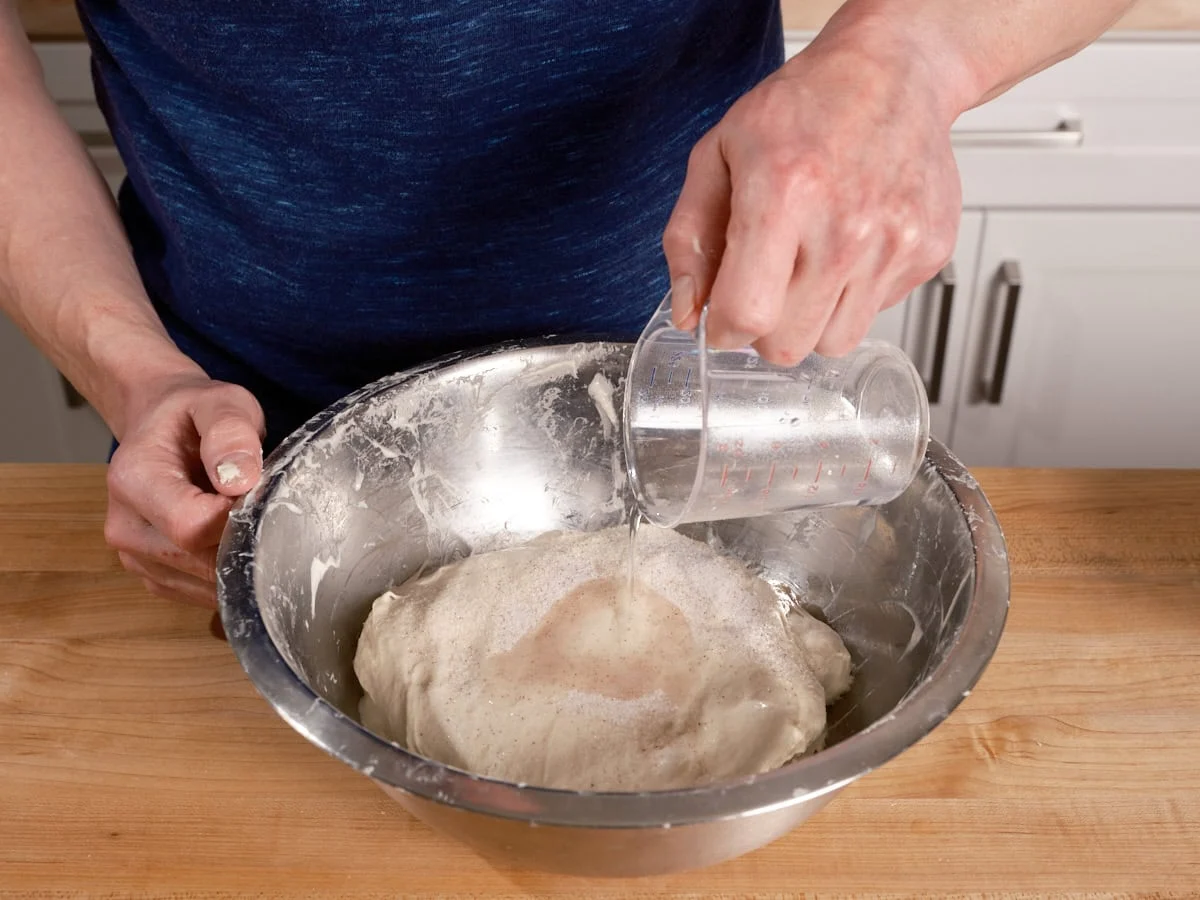
Bassinage (Double Hydration): This technique, also known as "double hydration," has become a cornerstone for achieving high hydration levels without compromising dough strength. Instead of incorporating all the water at the outset, a portion (typically 10-20% of the total water) is reserved and added gradually during the later stages of mixing. The initial mixing with less water allows for more efficient gluten development, as the dough is firmer and experiences greater friction. Once a foundational gluten network has begun to form, the reserved water is slowly incorporated, allowing the dough to absorb additional moisture while maintaining its structural integrity. This phased approach mitigates the risk of creating an excessively slack, underdeveloped dough that would be difficult to strengthen if all water were added upfront. Many professional recipes now incorporate this method, often designating "Water 1" for initial mixing and "Water 2" for bassinage, providing bakers with a crucial point of adjustment based on the dough’s real-time feel.
Reading the Dough: Perhaps the most valuable skill for any baker is learning to "read the dough" through touch and observation. This intuitive understanding transcends numerical percentages, recognizing that how a dough looks and feels in the mixing bowl is paramount. A dough that feels perfectly cohesive and elastic at 70% hydration with one flour might feel stiff or soupy with another. Experienced bakers assess consistency, extensibility (how far it stretches), and elasticity (how well it snaps back) to determine if more or less water is needed, irrespective of the recipe’s stated percentage. This sensory feedback loop is crucial for adapting to the inherent variability of ingredients and environment.
Addressing Common Challenges: Sticky Dough and Crumb Structure
Sticky dough is a frequent source of frustration for bakers. While often linked to hydration, it can also stem from other issues:
- Insufficient Gluten Development: A weak gluten network cannot adequately hold the water, leading to a dough that feels wet and sticky. Proper mixing, folding, and sufficient rest periods are essential for strengthening.
- Excess Water: Simply put, too much water for the flour’s absorption capacity will result in stickiness.
- Temperature: Warm doughs tend to be stickier and more challenging to handle. Controlling dough temperature is critical.
- Rapid Fermentation: Over-fermented dough can lose its structural integrity, becoming sticky and difficult to manage.
It is also a common misconception that higher hydration automatically equates to a more open crumb. While high hydration creates the potential for an open crumb, it is only one piece of the puzzle. Proper fermentation management, meticulous shaping techniques, and appropriate baking conditions (e.g., steam in the oven) are equally, if not more, crucial in achieving the desired internal structure. A tight crumb can result from an 80% hydration dough if other factors are neglected, just as a beautifully open crumb can be achieved with a moderate 68% hydration. Experts emphasize focusing on mastering all fundamental techniques rather than singularly chasing high hydration numbers.
Industry Perspectives and Future Outlook
The understanding and management of dough hydration are continually refined through ongoing research in cereal science and practical experimentation by artisan bakers. Flour mills increasingly provide detailed specifications on water absorption rates for their products, aiding bakers in precise formula development. The dialogue between flour producers, academic researchers, and professional bakers ensures that best practices evolve, adapting to new wheat varieties, milling technologies, and consumer demands.
Ultimately, dough hydration embodies the blend of art and science that defines baking. It requires a foundational understanding of chemical and physical processes, combined with the development of "baker’s intuition"—a sensitivity to ingredients and environment that allows for intelligent, real-time adjustments. By meticulously tracking hydration levels, observing dough behavior, and noting environmental conditions, bakers can cultivate this intuition, transforming recipes from rigid instructions into flexible blueprints for culinary creativity. The journey to mastering dough hydration is ongoing, promising endless opportunities for perfecting the craft of bread making.