Dough hydration, a seemingly straightforward metric, stands as one of the most profound and multifaceted variables in the intricate science of sourdough bread baking. Far from being a mere numerical value in a recipe, it represents a dynamic interaction between flour, water, and environmental conditions, demanding an adaptive approach from even seasoned bakers. This comprehensive guide delves into the scientific underpinnings and practical implications of hydration, illuminating its pivotal role in shaping the final characteristics of a sourdough loaf.
Defining Dough Hydration: The Fundamental Ratio
At its core, dough hydration quantifies the total water content in a recipe as a percentage of the total flour weight. The calculation is precise: divide the weight of the water by the total weight of the flour, then multiply by 100. For instance, a recipe calling for 1,000 grams of flour and 700 grams of water yields a 70% hydration dough (700 ÷ 1,000 × 100 = 70%). This percentage provides bakers with an essential preliminary understanding of the dough’s expected consistency and handling properties before the mixing process even begins.
However, a crucial insight for aspiring and experienced bakers alike is that this percentage serves as a guideline, not an immutable law. Flour, the primary ingredient, is a complex and variable product. Its characteristics can differ significantly across types, mills, and even individual bags, directly influencing its capacity for water absorption.
The Intricacies of Water Absorption: Flour as the Primary Determinant
The capacity of flour to absorb and retain water is the single most influential factor in determining appropriate hydration levels. This capacity is primarily governed by the flour’s protein content, starch composition, and the presence of bran and germ particles.
-
Protein Content and Gluten Formation: Higher-protein flours, typically categorized as "bread flour" (often 12-14% protein in North America), possess a greater capacity to absorb water. The proteins gliadin and glutenin, when hydrated, form gluten, a viscoelastic network crucial for trapping fermentation gases and providing structure. A higher protein content translates to a more robust gluten network, capable of supporting more water without collapsing. Conversely, lower-protein or "softer" flours, common in many European and South American regions, require reduced hydration to prevent an overly sticky and unmanageable dough, as their weaker gluten networks cannot sustain as much water. Failing to provide sufficient water to high-protein flour can lead to a dense, gummy crumb, while over-hydrating low-protein flour results in a soupy, unworkable mass.
-
Starch Absorption: While proteins are vital for structure, starches constitute the largest portion of flour by weight and also absorb a significant amount of water. Damaged starch granules, often a result of milling processes, absorb water more rapidly and in greater quantities than intact granules. The degree of starch damage varies between flour types and milling techniques, subtly influencing overall hydration needs.
-
Whole Grains and Bran/Germ: The inclusion of whole wheat, rye, or other whole-grain flours dramatically increases a dough’s water requirements. The bran and germ components, rich in dietary fiber and pentosans, are highly hydrophilic and absorb substantial moisture. For instance, a sourdough recipe incorporating 50% whole wheat flour might comfortably accommodate 82% hydration, a level that would render a 100% white flour dough extremely challenging to handle. These fibrous particles also physically interfere with gluten development, necessitating higher water content to ensure a tender crumb rather than a dense, dry one.
-
Freshly Milled Flour: Freshly milled flour typically exhibits a higher water absorption capacity compared to aged flour. This is partly due to the immediate availability of freshly exposed starch and protein structures, which have not yet undergone the slow oxidation processes that occur during aging. Even if sifted, fresh flour often demands increased hydration to achieve the desired dough consistency and texture.
Environmental Dynamics: Beyond the Recipe
While flour properties are paramount, ambient environmental conditions also play a measurable, albeit often subtler, role in hydration management.
-
Humidity: In highly humid environments, flour naturally absorbs moisture from the air, reducing the amount of water required in the recipe. Conversely, in arid climates, flour tends to be drier, necessitating higher hydration levels to reach the target consistency. Bakers in regions with significant daily or seasonal humidity fluctuations often adjust their water additions accordingly.
-
Altitude: High-altitude baking presents unique challenges, including faster fermentation rates and increased evaporation. While primarily impacting proofing times and oven spring, the drier atmospheric conditions at higher altitudes can also subtly increase a flour’s effective water absorption, requiring minor hydration adjustments.
-
Temperature: Dough temperature, influenced by ambient kitchen temperature and water temperature, impacts the rate of water absorption and gluten development. Warmer doughs absorb water faster, while colder doughs do so more slowly. Consistent temperature management is key to predictable hydration outcomes.
The Spectrum of Dough Hydration: Characteristics and Applications
The hydration percentage fundamentally dictates the physical attributes of both the dough and the final baked product. Understanding this spectrum allows bakers to tailor their approach to achieve specific textural and structural goals.
-
Lower-Hydration Bread (60-68%): Doughs in this range are stiffer, more resistant, and easier to handle, particularly for beginners. They typically result in loaves with:
- Thicker, more substantial crusts: Less water contributes to a denser crumb structure that supports a robust crust development.
- Chewy, tight crumb: The reduced moisture limits extensive gas expansion, leading to a closer, more uniform internal structure.
- Excellent shape retention: Stiffer doughs hold their form well during proofing and baking, making them ideal for intricately shaped breads like bagels, pretzels, certain pan loaves, and pizza dough.
- Longer shelf life: While subjective, some lower-hydration breads can maintain their structure and chewiness over a longer period.
-
Higher-Hydration Bread (75-85%+): These doughs are noticeably stickier, slacker, and more challenging to manage, demanding greater skill and experience. They are prized for producing loaves with:
- Brittle, thin crusts: The higher water content contributes to a lighter, more delicate crust that shatters beautifully.
- Open, airy crumb (alveoli): Abundant water facilitates greater gas expansion during fermentation and oven spring, creating large, irregular air pockets and a custard-like, melt-in-your-mouth interior.
- Improved tenderness and flavor development: The increased water allows for more efficient enzymatic activity and fermentation, leading to a more tender crumb and a richer, more complex flavor profile.
- Specific applications: Ideal for artisanal loaves like ciabatta, focaccia, and classic country sourdoughs known for their expansive crumb structure.
It is important to note that pushing hydration to extreme levels (e.g., 100% or more) solely for the sake of a high number can be counterproductive. Beyond a certain point, excessive water compromises structural integrity, leading to loaves with a gummy crumb, poor volume, or an inability to retain shape post-baking. The goal is always optimal hydration for the specific flour and desired outcome, not merely the highest possible percentage.
Mastering Dough Consistency: Visual and Tactile Cues
One of the hallmarks of an intuitive baker is the ability to "read the dough" rather than strictly adhering to numerical percentages. The feel and appearance of the dough in the mixing bowl are often more telling than the calculated hydration percentage, as flour variability can make a 70% hydration dough feel vastly different depending on its source.
-
Under-Hydrated Dough (e.g., ~62% or less with medium-protein white flour):
- Appearance: Crumbly, dry, shaggy, and often appears to have dry flour streaks.
- Feel: Stiff, resistant, very difficult to mix by hand. It will not easily incorporate all ingredients.
- Behavior: Lacks extensibility, tears easily when stretched, does not develop a smooth surface. During bulk fermentation, it remains dense and lacks elasticity.
- Implications: Results in a dense, tight crumb, poor oven spring, and a hard, thick crust.
-
Optimal Hydration Dough (e.g., ~68-75% with medium-protein white flour):
- Appearance: Smooth, cohesive, elastic, and pulls cleanly away from the sides of the bowl.
- Feel: Pliable, extensible, slightly tacky but manageable. It exhibits a pleasant resistance when stretched.
- Behavior: Stretches into a thin, translucent membrane (windowpane test), indicating well-developed gluten. It holds its shape during bulk fermentation and shaping, showing good extensibility and elasticity.
- Implications: Leads to a well-structured crumb, good oven spring, and a desirable crust texture.
-
Over-Hydrated Dough (e.g., ~75%+ with medium-protein white flour):
- Appearance: Very wet, slack, soupy, spreads rapidly on a surface.
- Feel: Excessively sticky, clings aggressively to hands and surfaces, lacks tension.
- Behavior: Difficult to handle and shape, offers little resistance, may not hold its form during proofing. The gluten network struggles to support the water, leading to collapse.
- Implications: Can result in a flat, dense, or gummy crumb due to poor gas retention, limited oven spring, and a crust that may lack structure or become overly brittle.
Advanced Techniques: Phased Water Addition (Bassinage)
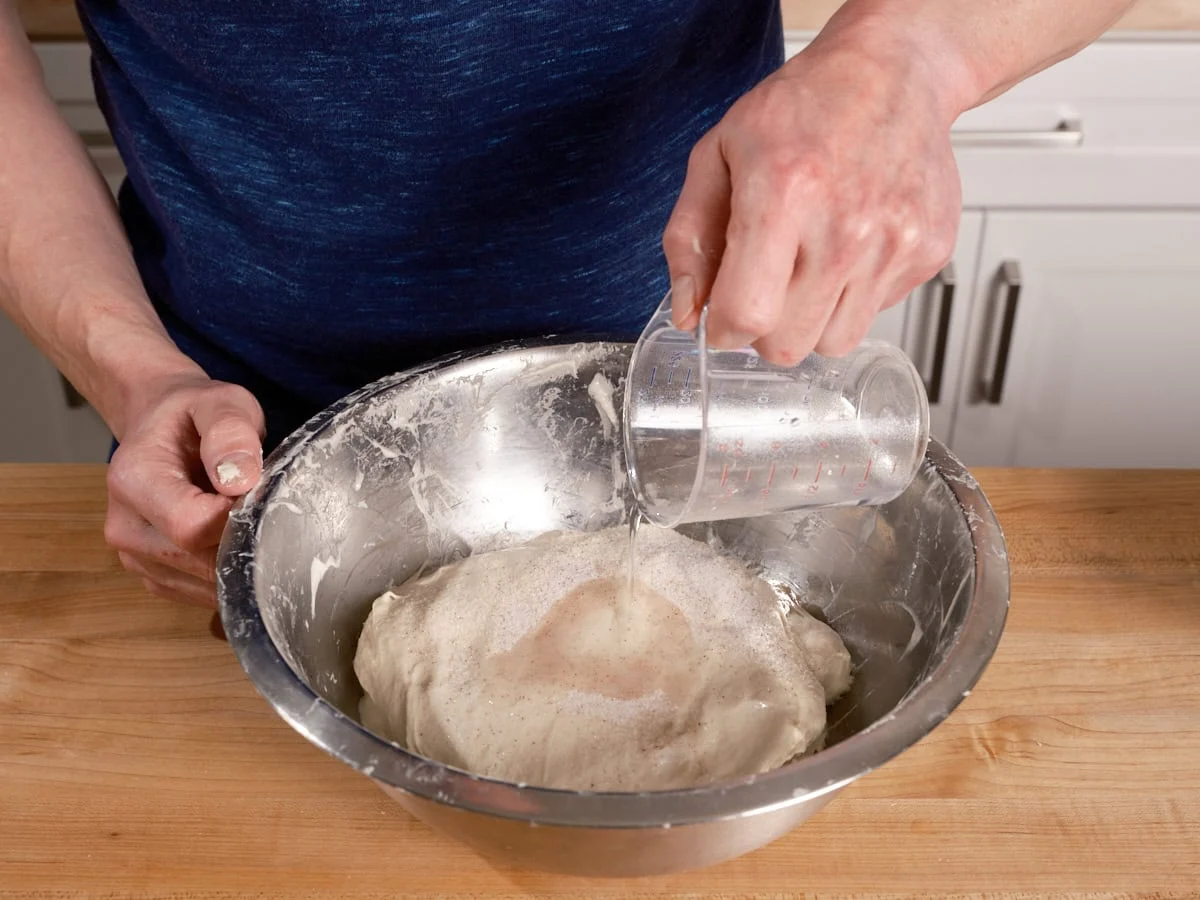
To manage higher hydration levels effectively and mitigate the challenges of sticky dough, many artisan bakers employ a technique known as bassinage, or "double hydration." This method involves reserving a portion of the mixing water and incorporating it gradually after the initial gluten development has commenced.
-
Facilitating Gluten Development: Adding all water upfront, especially in high-hydration recipes, can make efficient gluten development difficult. A very wet initial mixture lacks the friction necessary for the proteins to align and form a strong network. By adding 80-90% of the water initially, mixing until a foundational gluten structure begins to form, and then slowly incorporating the reserved water, bakers can achieve higher hydration without excessively long mixing times or the risk of under-developed dough. The initial "drier" mix allows the gluten to come together more easily before being further hydrated.
-
Adaptive Hydration Management: Bassinage provides a critical opportunity to assess the dough’s strength and adjust hydration in real-time. If the dough feels exceptionally wet or slack after the initial water addition, the reserved bassinage water can be reduced or entirely omitted. Conversely, if the dough is strong and appears capable of absorbing more liquid, the remaining water can be carefully added. This adaptive strategy accounts for the inherent variability of flour and environmental conditions, ensuring optimal dough consistency regardless of minor recipe deviations.
Addressing Common Baking Challenges: The Sticky Dough Dilemma
Sticky dough is a frequent source of frustration for bakers, often stemming from issues related to hydration, dough strength, or a combination of both.
- Under-Developed Gluten: Insufficient mixing or folding prevents the gluten network from fully forming, leaving the dough slack and unable to manage its water content effectively.
- Over-Hydration: Simply too much water for the flour’s capacity, leading to a soupy, unmanageable consistency.
- Weak Flour: Flour with low protein content or poor protein quality cannot form a strong enough gluten network to support even moderate hydration.
- Insufficient Fermentation: While hydration affects dough feel, proper fermentation is crucial for developing strength and elasticity. Under-fermented dough can feel dense and sticky.
- Improper Handling: Overworking sticky dough with too much flour on the counter can dry out the surface while the interior remains wet, leading to an inconsistent texture.
Strategic Approaches for High-Hydration Doughs
Working with high-hydration doughs requires specific techniques to manage their inherent slackness and stickiness.
- Utilize Bassinage: As discussed, phased water addition is crucial for developing strength in wet doughs.
- Develop Strong Gluten: Longer mixing times or a series of vigorous stretch and folds during bulk fermentation are necessary to build a robust gluten network capable of holding more water.
- Work on a Wet Surface: Instead of dusting with flour, lightly wet your hands or the work surface to prevent sticking when handling very wet doughs.
- Employ Gentle Handling: High-hydration doughs are delicate. Use a light touch during shaping and avoid aggressive degasification, which can compromise the fragile air pockets.
- Cold Fermentation: Retarding dough in the refrigerator slows fermentation and stiffens the dough, making it easier to handle and shape, particularly for very wet recipes.
- Specialized Tools: A bowl scraper, bench scraper, or even a dough whisk can be invaluable for managing sticky doughs without excessive hand contact.
Industry Perspectives and Broader Implications
In commercial baking, precise hydration control is paramount for consistency, automation efficiency, and product uniformity. Large-scale bakeries employ sophisticated mixing equipment and quality control measures to standardize flour and water ratios, ensuring batch-to-batch consistency. The shelf life of commercial bread, a critical economic factor, is also influenced by hydration; optimal moisture content can extend freshness while excessive hydration can lead to faster staling or mold growth if not properly stored. Consumer preferences also drive hydration trends, with a growing demand for artisanal, open-crumb sourdough loaves pushing bakers to master higher hydration techniques.
Conclusion: Cultivating Baker’s Intuition
Ultimately, understanding dough hydration transcends formulas and percentages; it is about developing a profound sensitivity to the living material that is bread dough. This "baker’s intuition" is honed through observation, tactile experience, and meticulous record-keeping. By documenting the specific flour used, environmental conditions, dough feel at various stages, and the final loaf’s characteristics, bakers gradually build an empirical knowledge base. This allows them to interpret the subtle cues their dough provides, adapting recipes on the fly and transforming hydration from a rigid rule into a flexible, responsive dialogue with their ingredients. The journey to mastering dough hydration is a testament to the dynamic interplay of science, craft, and intuition at the heart of exceptional bread baking.