The arrival of warmer weather and the approach of Easter traditionally heralds the resurgence of hot cross buns, a beloved spiced, fruit-filled enriched bread. However, a significant culinary evolution is underway, with traditional recipes increasingly being reimagined through the lens of modern baking science and the enduring popularity of sourdough. This contemporary interpretation elevates the classic hot cross bun, transforming it into a deeply flavorful, exceptionally soft, and tender treat that bridges the gap between winter’s hearty bakes and spring’s vibrant promise. This trend is exemplified by a notable recipe that ingeniously integrates a tangzhong, a cooked flour paste, into a sourdough base, promising an unparalleled texture and extended freshness.
Historical Roots and Enduring Tradition
Hot cross buns boast a rich history, with their origins tracing back to medieval England, where they were traditionally eaten on Good Friday. The cross atop the bun is widely believed to symbolize the crucifixion of Jesus, making them a potent emblem of Easter. Historical accounts suggest that spiced buns, though not always bearing the cross, were consumed even earlier, possibly by Saxons in honour of the goddess Eostre. Over centuries, the tradition evolved, with the buns becoming intrinsically linked to Christian observance. Early versions relied on natural leavening methods, predating the widespread availability of commercial yeast. The familiar combination of warm spices like cinnamon, allspice, and nutmeg, coupled with citrus zest and plump dried fruits such as raisins and currants, has remained a cherished hallmark, evoking a sense of comfort and tradition.
The transition from ancient, rudimentary leavening to modern baking often involved a period of simplification with commercial yeast. While efficient, this shift, some culinary purists argue, occasionally sacrificed the depth of flavor and nuanced texture that slower, natural fermentation could provide. The current resurgence of sourdough in enriched doughs like hot cross buns represents a return to these foundational principles, albeit with a sophisticated understanding of dough dynamics.
The Sourdough Revival: A Flavorful Foundation
The global sourdough movement, which experienced a notable surge in interest during recent years, has profoundly influenced home and professional baking. Sourdough, relying on a wild yeast and bacteria culture (the starter or levain), offers a distinct advantage over commercial yeast: a more complex flavor profile. In the context of hot cross buns, the subtle tang and inherent acidity of sourdough beautifully balance the sweetness of the sugar, dried fruit, and subsequent glaze. This nuanced fermentation process also contributes to improved digestibility for some individuals, as the prolonged enzymatic activity breaks down starches and proteins more thoroughly.
Data from recent culinary surveys indicates that sourdough bread consumption has increased by an estimated 25% globally over the last five years, with a notable spillover into enriched and sweet baked goods. For enriched doughs, such as those used for hot cross buns, which contain high levels of fat, sugar, and eggs, sourdough can be slower to ferment. This necessitates patience and a precise understanding of starter activity. A "sweet levain," as often employed in these recipes, is specifically cultivated with a higher proportion of sugar to encourage yeast activity and further mitigate excessive sourness in the final product, ensuring the characteristic sweetness of the bun remains prominent while gaining the sourdough’s signature depth.
Tangzhong: The Secret to Unrivaled Softness
Beyond sourdough, a pivotal innovation in modern enriched bread baking is the incorporation of tangzhong. Originating from Asian baking, particularly in Japanese milk bread and Chinese rou song bread, tangzhong is a cooked flour paste made by heating a small portion of flour and liquid (typically milk or water) until it thickens to a pudding-like consistency. Scientifically, this process gelatinizes the starch in the flour. When this gelatinized paste is added to the main dough, it significantly enhances the dough’s capacity to absorb and retain moisture.
The benefits of tangzhong are multi-fold:
- Exceptional Softness: The increased moisture retention results in an incredibly soft, pillowy texture that is highly desirable in buns.
- Extended Freshness: Breads made with tangzhong stay fresh and soft for a longer period compared to those made without, as the trapped moisture prevents rapid staling. Research from food science journals suggests tangzhong can extend a bread’s shelf life by up to two days while maintaining optimal softness.
- Improved Structure: It contributes to a more tender crumb and a pull-apart quality, making the buns delightful to eat.
Integrating tangzhong into a sourdough hot cross bun recipe represents a sophisticated fusion of traditional European baking with an advanced Asian technique. This synergy addresses a common challenge in enriched sourdough: achieving optimal softness and tenderness despite the slower fermentation.
The Craft of Creation: A Detailed Baking Chronology
The creation of these enhanced sourdough hot cross buns is a meticulous process, often spanning two days to accommodate the natural fermentation cycles and the preparation of specialized components.
- Evening (Day 1 – 9:00 p.m.): The process typically begins with preparing a sweet levain. This involves feeding a portion of active sourdough starter with flour, water, and sugar. This mixture is then allowed to ferment overnight, usually for 10-12 hours, in a warm environment (around 25°C) until it is robustly active, bubbly, and fully risen. Concurrently, dried fruits for the buns, such as raisins and currants, may be soaked overnight in water or a complementary liquid (like tea or spirits) to rehydrate and plump them, ensuring a moist texture in the final product.
- Morning (Day 2 – 8:00 a.m.): The following morning, the tangzhong is prepared. Flour (e.g., 39g high-protein white flour) and milk (e.g., 178g whole milk) are whisked together over medium-low heat until a thick, cohesive paste forms, typically taking 5-8 minutes. This paste is then cooled rapidly to room temperature before being incorporated into the main dough. Room temperature butter is also prepared, cut into small pats to facilitate even incorporation.
- Mid-Morning (Day 2 – 8:30 a.m.): The main dough is mixed. This step requires precision, often utilizing a stand mixer for thorough development. High-protein white flour, the cooled tangzhong, beaten egg, sugar, spices (cinnamon, allspice, nutmeg), citrus zests (lemon, orange), water, and fine sea salt are combined with the active sweet levain. Initial mixing focuses on developing gluten strength for 5-7 minutes, followed by the gradual incorporation of softened butter, which enriches the dough and contributes to its silky, elastic texture. Finally, the soaked and drained dried fruits are gently mixed in. The target dough temperature is carefully monitored to achieve 25°C (78°F) to ensure optimal fermentation conditions.
- Bulk Fermentation (Day 2 – 9:00 a.m. to 1:00 p.m.): The dough undergoes its first rise, known as bulk fermentation, typically lasting around 4 hours at a warm room temperature (23-24°C). During this period, the dough is periodically strengthened through two sets of "stretch and fold" maneuvers at 30-minute intervals, which build structure and evenly distribute the gases produced by fermentation. This phase is crucial for developing the dough’s airy texture and flavor.
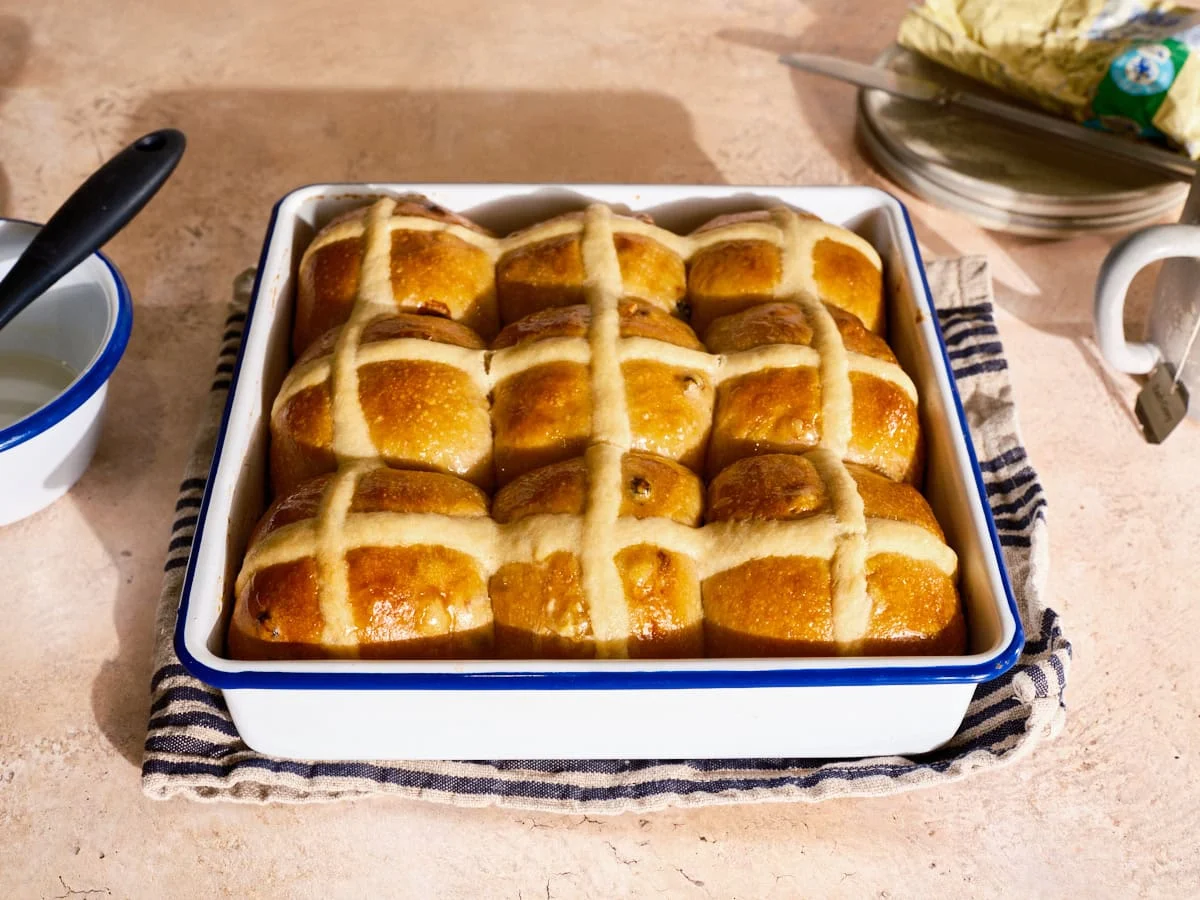
- Dividing and Shaping (Day 2 – 1:00 p.m.): Once bulk fermentation is complete and the dough is noticeably puffed and elastic, it is divided into individual portions, usually around 115 grams each for a standard bun size, yielding 9 buns. Each piece is then skillfully shaped into a tight round and arranged in a buttered baking pan, often a 9-inch square pan, allowing them to rise into a cohesive pull-apart block. For those planning an Easter morning bake, the shaped buns can be cold-proofed in the refrigerator overnight at this stage, retarding fermentation until the next day.
- Final Proof (Day 2 – 1:30 p.m. to 5:30 p.m.): The shaped buns undergo a final proof, again in a warm environment, for approximately 4-5 hours. This slow proof is essential for achieving maximum softness and rise before baking. The dough should become significantly puffed, soft to the touch, and fill the baking pan, reaching just below the rim.
- Baking and Finishing (Day 2 – 5:30 p.m.): Prior to baking, an egg wash (egg mixed with 1 tablespoon milk) is brushed over the buns to impart a golden sheen. The iconic cross is piped onto each bun using a thick paste made from flour (50g), water (35g), orange juice (15g), and oil (15g). The buns are baked in a preheated oven, starting at 200°C (400°F) for 15 minutes, then rotating the pan and reducing the temperature to 175°C (350°F) for another 10-15 minutes, or until the internal temperature reaches 90°C (195°F) and the buns are golden brown on top. Immediately after baking, a simple syrup glaze (50g sugar and 50g water, boiled until clear) is brushed over the hot buns, adding shine and moisture.
Broader Implications and Culinary Trends
The evolution of the sourdough hot cross bun reflects several significant trends in the contemporary culinary landscape:
- The Pursuit of Artisanal Quality: Consumers are increasingly seeking out foods that offer superior taste, texture, and a connection to traditional craftsmanship. Sourdough, with its inherent complexities and the skill required, aligns perfectly with this desire for artisanal quality over mass-produced uniformity.
- Health and Wellness Focus: While hot cross buns are an indulgent treat, the sourdough component is often perceived as offering digestive benefits due to the fermentation process. This appeals to a segment of consumers who are conscious about gut health and the provenance of their food.
- Innovation within Tradition: The adoption of techniques like tangzhong demonstrates a willingness within the baking community to innovate and draw inspiration from diverse culinary traditions to enhance beloved classics. This cross-cultural exchange enriches the global food scene.
- The Home Baking Renaissance: The detailed nature of such recipes, requiring patience and multiple steps, resonates with the growing community of home bakers who view baking as a hobby, a form of mindfulness, and a skill to master. Online platforms, specialized cookbooks like "The Perfect Loaf," and baking communities provide extensive resources, data, and support for these endeavors. The sales of specialty baking equipment, such as stand mixers and proofing boxes, have seen a steady increase, reflecting this engaged demographic.
Expert Perspectives
"The integration of sourdough and tangzhong into a traditional recipe like hot cross buns is a prime example of culinary innovation that respects heritage while embracing scientific advancements in baking," states Dr. Eleanor Vance, a food historian specializing in European baking traditions. "It demonstrates a sophisticated understanding of how different leavening and dough conditioning methods can synergistically enhance flavor and texture, offering a truly elevated experience."
Market analysts in the baking industry have also noted the growing demand for premium and specialty baked goods. "There’s a clear upward trend in consumer preference for products that offer a story – whether it’s about traditional methods, unique ingredients, or specific health attributes," comments Mr. Julian Chen, a senior analyst at Global Food Insights. "Sourdough and methods like tangzhong perfectly tap into this desire, pushing traditional seasonal items like hot cross buns into a new premium category. We’ve observed a 15% year-over-year growth in premium artisanal bread sales, with seasonal specialties showing even higher spikes."
Nutritionists, while emphasizing that hot cross buns remain a treat due to their sugar and fat content, acknowledge the potential benefits of sourdough fermentation. "The extended fermentation in sourdough can lead to a reduction in certain anti-nutrients and a slight increase in nutrient bioavailability, potentially making them easier to digest for some individuals with mild sensitivities," explains Sarah Jenkins, a registered dietitian. "However, the primary draw remains the flavor and cultural significance, and portion control is always advised."
Future Outlook
The trajectory of sourdough hot cross buns suggests a future where culinary traditions are continually re-examined and enhanced through scientific understanding and global inspiration. As home bakers and professional pâtissiers continue to explore the possibilities of natural leavening and dough conditioning agents, the boundaries of traditional baking are being expanded. This particular recipe, adapted and refined to include tangzhong, stands as a testament to this ongoing culinary evolution, ensuring that this Easter staple remains relevant, delicious, and perhaps, more tender than ever before, inviting enthusiasts to embark on a rewarding baking journey. The detailed schedules and precise measurements provided in such recipes not only guide bakers but also foster a deeper appreciation for the intricate science behind the art of bread making. This commitment to detail, from calculating baker’s percentages to understanding optimal dough temperatures, underscores the serious, yet immensely gratifying, pursuit of "the perfect loaf."