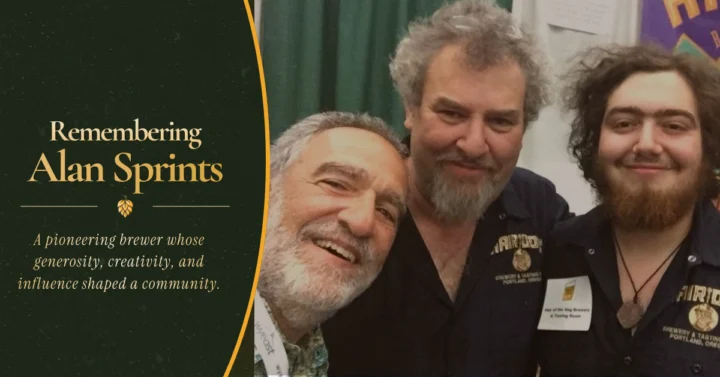
Alan Sprints, a pioneering force in the craft beer movement and the visionary founder of Portland’s acclaimed Hair of the Dog Brewing Company, passed away on July 14, 2026, at the age of 61, following a courageous battle with metastatic stage 4 bladder cancer. Sprints, widely recognized for his innovative approach to brewing and his creation of cult-favorite, limited-edition "white whale" beers, leaves an indelible legacy on the American craft beer landscape. His passing has sent ripples of sadness through the brewing community, with countless brewers, enthusiasts, and friends remembering his passion, generosity, and unparalleled dedication to the art and science of beer.
A Legacy of Innovation and "White Whale" Beers
Sprints first gained significant recognition for his intensely flavored, high-alcohol ales, many of which quickly became legendary among beer aficionados. His most celebrated creation, "Adam," introduced in 1994, was a bold reimagining of the historical German strong ale known as Adambier. Michael Jackson, the esteemed beer writer, had chronicled Adambier in his seminal work, Beer Companion, and Sprints took this obscure historical style and infused it with his unique brewing philosophy. Adam was a dark, 10% ABV Old Ale, characterized by a formidable 60 IBUs, a complexity that allowed it to age with remarkable grace. At a time when the craft beer scene was still in its nascent stages, Adam stood out as a beer of exceptional character and profound depth, setting a new benchmark for what American breweries could achieve.
Following the success of Adam, Sprints introduced "Fred" in 1997. Named in honor of Fred Eckhardt, a revered Portland-based beer historian and a significant figure in the craft and homebrewing world, Fred was inspired by the Belgian Golden Strong Ale style. This dark gold, 10% ABV ale proved to be even more elusive and coveted than its predecessor, further cementing Hair of the Dog’s reputation for producing beers that were not only exceptional in quality but also highly sought after. The scarcity and exceptional aging potential of these beers cultivated a dedicated following, turning them into genuine "white whales" for collectors and enthusiasts eager to experience Sprints’ unique creations.
Early Life and the Genesis of Hair of the Dog
Born in the Los Angeles area, Sprints’ early career path was diverse, initially involving aerospace and music before he found his calling as a chef. His passion for brewing began as a homebrewing endeavor. This foundational experience in crafting beer from scratch provided him with an intimate understanding of ingredients and fermentation, which he would later translate into his professional brewing career.
In 1991, Sprints moved to Portland, Oregon, and began his professional brewing journey at Widmer Brothers. During this period, he became an active member of the local homebrewing community, joining and eventually leading the Oregon Brew Crew as club president. His tenure at Widmer Brothers, following his time as a chef, provided him with invaluable professional brewing experience. After three years as a chef and two years as a professional brewer, Sprints felt ready to embark on his own entrepreneurial venture.
In 1993, Sprints officially opened Hair of the Dog Brewing Company in a somewhat unconventional industrial district in Southeast Portland. The brewery quickly became a hub for experimental brewing, pushing the boundaries of traditional beer styles. Beyond his reinterpretations of historical ales, Sprints was also an early adopter and innovator in barrel aging techniques. This forward-thinking approach garnered significant accolades from prominent beer publications such as Beer Advocate and Whiskey Advocate, recognizing his mastery in melding complex flavors and aging beer to perfection.
A Culinary and Brewing Mastermind
Matt Simpson, founder of The Beer Sommelier, articulated the profound impact of Sprints’ brewing philosophy: "Alan Sprints didn’t create the barleywine style – he perfected it. He didn’t invent barrel-aged beers – he curated and melded them like nobody at the time could or would." This sentiment underscores Sprints’ unique ability to not just follow trends but to define them, elevating the perception and appreciation of complex, barrel-aged beers.
Personal Reflections from the Brewing Community
The personal accounts of those who knew Sprints paint a picture of a man deeply committed to his craft and remarkably generous with his knowledge and resources. Drew Beechum, a Founding Board member of the American Homebrewers Association and an author, recalled Sprints with immense fondness: "He was a homebrewer at heart – always super generous with his time and enthusiasm (and his cellar)."
Beechum’s recollections vividly illustrate the early days of Hair of the Dog and Sprints’ inclusive spirit. "The original Hair of the Dog location was in this weird old half broken down warehouse along the river and the train tracks in Portland," Beechum stated. "And every year before Oregon Brewers’ Fest he would host a private party at the brewery. I found out about it and as an eager, super-new brewer. I wandered around until I stumbled across the brewery (this was before Google Maps, cellphones and a public taproom!). Despite not knowing me from Adam, Sprints welcomed me to his party and to his giant feast. He handled my enthusiastic babble, proudly showed off his 4-barrel steam jacketed kettle that had been used by Campbell’s to boil peas (I think – it was definitely Campbell’s)." Beechum further described the amusing contrast between the massive malt silo at the brewery and the relatively smaller kettle, a testament to Sprints’ ambitious brewing scale. "He laughed at the observation and handed me a glass of the fabled Dave from a secret Golden Gate keg hanging out in the corner," he added, highlighting Sprints’ willingness to share his prized creations.
Another anecdote from Beechum further emphasizes Sprints’ generosity and celebratory nature. During a visit to the Bay Area, Sprints surprised Beechum’s homebrew club, the Falcons, who were celebrating their win as Anchor’s California Homebrew Club of the Year. "One year the Falcons were in San Francisco celebrating our win as Anchor’s California Homebrew Club of the Year and ended our weekend at the Celebrator Beer News Party at Trumer Brewery in Berkeley," Beechum recounted. "We had a big table and were having a blast when Alan shows up and drops two magnums of Doggie Claws Barleywine as a ‘congratulations’ gift. But what made it epically funny is that every time we drained a bottle, Alan was suddenly back like a mischievously grinning Santa Claus with another pair of magnums." These stories highlight Sprints’ larger-than-life personality and his profound impact on the individuals he encountered.
A Significant Loss to the Brewing Community
The news of Alan Sprints’ passing has been met with widespread sorrow. Charlie Papazian, a foundational figure in American craft brewing and the founder of the Brewers Association, expressed his condolences, noting Sprints’ immense contributions. While specific quotes from Papazian were not included in the initial report, his historical connection to the homebrewing community and his relationship with Sprints suggest a shared understanding of the void left by his departure.
The implications of Sprints’ passing extend beyond the immediate grief. His pioneering work in developing and popularizing complex, aged beers has influenced generations of brewers. The concept of the "white whale" beer, while sometimes commercially exploited, was initially born from a genuine desire to create beers of exceptional character that evolved over time, a philosophy Sprints masterfully embodied. His dedication to historical styles and his innovative use of barrel aging have become cornerstones of modern craft brewing.
Alan Sprints is survived by his family and a vast network of friends and colleagues who were touched by his passion and vision. His absence will be keenly felt by the homebrewing and craft brewing communities, who will continue to celebrate his innovative spirit and the enduring legacy of the beers he so meticulously crafted. The impact of his work will undoubtedly continue to inspire brewers and delight beer enthusiasts for years to come.